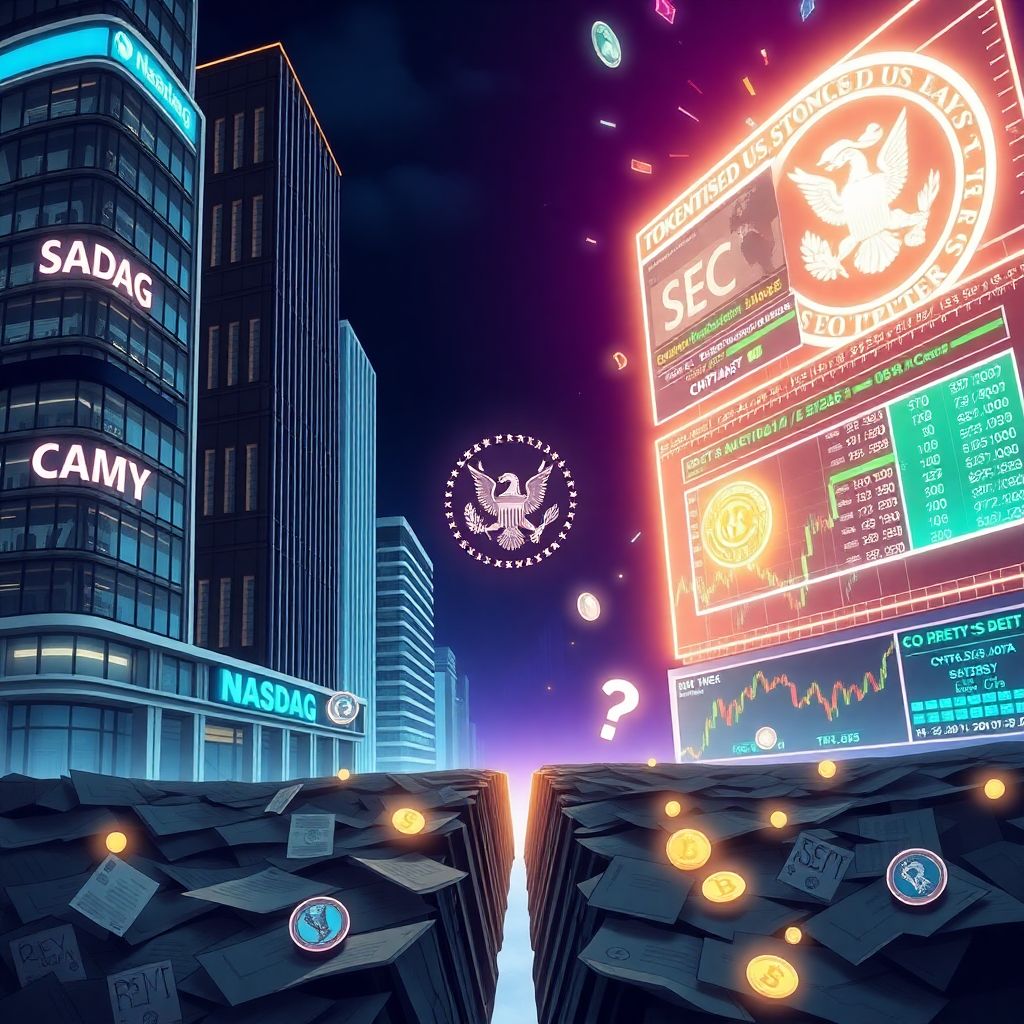
Global Exchanges Press SEC to Rein In Crypto Exemptions, Flag Dangers of Tokenized Stocks
A powerful bloc of traditional stock exchanges is urging U.S. regulators to take a much harder line on crypto companies that want to offer tokenized versions of U.S. equities.
In a recent letter to the U.S. Securities and Exchange Commission’s Crypto Task Force, the World Federation of Exchanges (WFE) warned that broad regulatory exemptions for crypto firms could undermine decades of carefully built investor protections. The WFE’s membership includes some of the world’s most influential market operators, such as Nasdaq, Cboe, and CME Group, giving its position significant weight in ongoing policy debates.
The core of the WFE’s message is that crypto platforms should not be allowed to function like national securities exchanges “through the back door.” According to the letter, so‑called “exemptive relief” — special permissions that let firms sidestep certain rules — must not become a shortcut that lets tokenized stock platforms operate exchange‑like services without having to meet the full regulatory obligations required of traditional stock markets.
The federation said it is “alarmed” by the rapid growth in the number of brokers and crypto trading venues either already offering or planning to offer “tokenised US stocks.” These are digital tokens that claim to track or represent shares of publicly listed companies, often marketed as a way to trade equities 24/7, fractionalize ownership, or make cross‑border investing easier. The WFE argues that, in practice, many of these products blur critical legal and operational lines and could leave investors confused about what they actually own and what protections they have.
Tokenized stocks typically sit in a grey zone between established securities law and novel blockchain structures. In some cases, they may be backed 1:1 by real shares held in custody. In others, they may simply mirror the price of an underlying stock through derivatives, synthetic exposure, or algorithmic mechanisms. The WFE warns that without clear and robust regulation, investors may wrongly assume that these tokens carry the same rights, disclosures, and safeguards as conventional shares listed on regulated exchanges.
Another key concern raised by the federation is market integrity. Traditional exchanges are subject to strict rules on surveillance, transparency, fair access, and conflict‑of‑interest management. By contrast, many crypto platforms operate with lighter oversight, limited transparency into order books and market‑making practices, and far less stringent rules on how customer assets are held and protected. Allowing such platforms to list tokenized versions of regulated securities, the WFE argues, risks creating regulatory arbitrage — where the same economic exposure is offered under very different standards.
The letter also hints at systemic risk. If tokenized versions of major U.S. stocks proliferate on loosely regulated venues, price distortions, outages, or failures in those markets could potentially spill over into the underlying securities. Conflicting prices between token markets and traditional exchanges could confuse investors, fuel arbitrage strategies that strain liquidity, or erode trust in official price discovery mechanisms.
From an investor‑protection perspective, the federation emphasizes information asymmetry and legal uncertainty. Many retail traders may not understand that buying a tokenized stock is not the same as holding a share in a brokerage account on a regulated exchange. They may lack voting rights, dividend entitlements, or clear recourse if the platform fails. Disclosures around custody, redemption rights, and the legal nature of the token are often sparse or highly technical, making it difficult for non‑expert investors to assess their real risks.
The WFE’s position reflects a broader tension between innovation and regulation in financial markets. On one hand, tokenization promises faster settlement, fractional ownership, and global access — features that could, in theory, improve market efficiency and inclusion. On the other hand, when these innovations are layered on top of core securities like U.S. stocks, regulators and incumbent exchanges argue that they must be subject to the same robust rules that govern traditional markets, not looser crypto‑specific regimes.
For the SEC, the federation’s intervention comes at a critical moment. The agency has been under pressure to clarify how securities laws apply to digital assets, including tokenized products that closely resemble traditional financial instruments. Granting piecemeal exemptive relief to individual platforms may seem like a pragmatic way to experiment. But the WFE warns that doing so without imposing full exchange‑level obligations risks creating a fragmented, uneven regulatory landscape that ultimately harms investors.
In practical terms, the exchanges are effectively asking the SEC for two things: first, to resist granting broad exemptions that allow crypto platforms to act like exchanges for tokenized stocks without fully registering and complying; and second, to ensure that any tokenization of securities occurs within a framework that preserves core protections — including transparent trading rules, strong custody requirements, effective market surveillance, and clear legal rights for investors.
For crypto firms, this stance signals that tokenized stocks are likely to face a far tougher regulatory path than many had hoped. Platforms that want to offer tokenized exposure to U.S. equities may need to partner more closely with regulated intermediaries, obtain additional licenses, or redesign their products to fit clearly within existing securities laws. The days of lightly regulated tokenized stock offerings marketed as simple “crypto alternatives” to brokerage accounts may be numbered.
Looking ahead, one possible compromise lies in on‑chain representations of securities issued directly by regulated entities or through fully registered alternative trading systems. In such models, tokenization is used as a technological upgrade to existing capital markets infrastructure, not as a way to route around it. The WFE’s message suggests that traditional exchanges are open to innovation — but only if it is built atop the same regulatory foundations that have long governed public markets.
For investors, the debate is a reminder to look beyond marketing labels and understand precisely what a token represents, who stands behind it, and what legal protections apply. Whether regulators follow the WFE’s recommendations or take a more permissive approach, the risks around tokenized stocks remain significant for anyone who treats them as simple substitutes for owning traditional shares.
Ultimately, the clash over tokenized equities is not just about crypto versus traditional finance. It is about who controls access to the most important financial assets in the world, under what rules, and with what level of accountability. The WFE is betting that regulators will choose continuity of investor protection over rapid, lightly regulated experimentation — and is urging the SEC to make that choice explicit as it weighs the future of tokenized U.S. stocks.