Ethereum ETFs finally flip back to inflows after eight straight days of redemptions, yet the brief return of demand has done little to revive the price of ETH, which remains stuck below the psychologically important 2,800 dollar level.
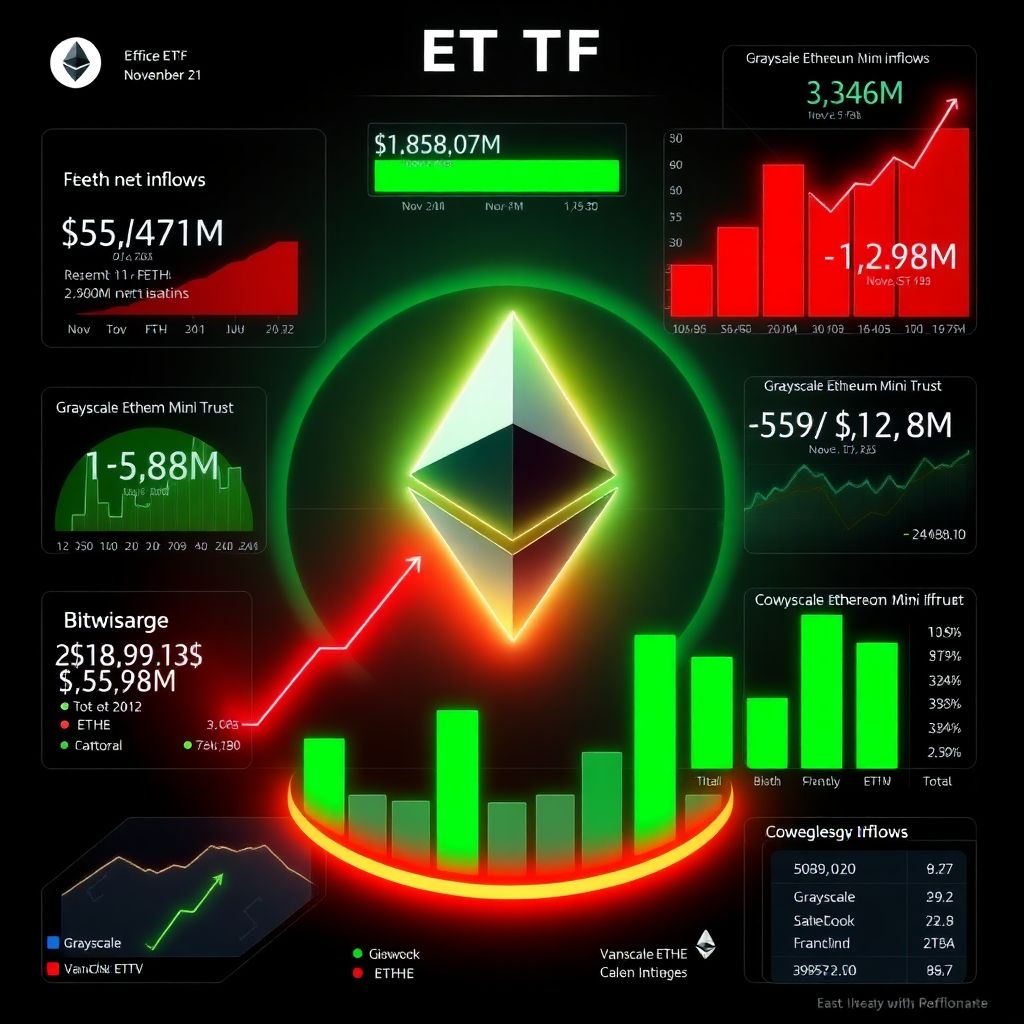
On 21 November, spot Ethereum exchange-traded funds registered a combined 55.71 million dollars in net inflows, interrupting a bruising streak of more than 1.3 billion dollars in outflows that had persisted from 11 to 20 November. The shift suggests some investors are starting to step back in after aggressive profit-taking and risk reduction. Even so, Ether’s spot price continues to lag the broader market.
Fidelity leads ETF rebound as BlackRock continues to see redemptions
The day’s flows were anything but uniform across issuers. Fidelity’s FETH was the clear standout, attracting 95.40 million dollars in fresh capital and emerging as the main driver of the ETF recovery. That single-day haul pushed FETH’s cumulative net inflows to approximately 2.54 billion dollars, underlining its growing importance within the Ethereum ETF landscape.
In sharp contrast, BlackRock’s ETHA product remained deep in outflow territory even on the day of overall positive flows. ETHA saw 53.68 million dollars in redemptions on 21 November, which significantly offset the gains brought in by Fidelity and a handful of smaller players. Despite the ongoing withdrawals, ETHA continues to dominate the segment in absolute terms, with cumulative net inflows of around 12.89 billion dollars — the largest among Ethereum ETFs.
Other issuers saw more modest but still noteworthy inflows. Grayscale’s Ethereum Mini Trust added 7.73 million dollars, taking its total net inflows to roughly 1.42 billion dollars. Bitwise’s ETHW vehicle attracted 6.26 million dollars, lifting its cumulative assets to about 399.30 million dollars.
By comparison, several major products were effectively dormant on the day. Grayscale’s flagship ETHE, VanEck’s ETHV, Franklin’s EZET, 21Shares’ TETH and Invesco’s QETH all reported zero net flow activity on 21 November, signaling a wait-and-see posture among some institutional and advisory clients.
Ethereum ETF market size and trading activity
As of 21 November, total net assets under management across all Ethereum ETFs stood at approximately 16.86 billion dollars. Cumulative total net inflows into ETH-focused funds reached 12.63 billion dollars, underscoring the scale of institutional and structured-product demand that has built up since these vehicles launched.
Trading activity remains robust, though it has cooled slightly alongside the broader market pullback. On 21 November, the aggregate trading value for Ethereum ETFs was about 2.30 billion dollars, down from 2.76 billion dollars recorded the previous day. The decline in turnover reflects a period of consolidation after intense selling pressure in mid-November.
Eight days, 1.3 billion dollars: breaking down the outflow streak
The single day of net inflows came on the heels of a punishing series of redemptions. Between 11 and 20 November, Ethereum ETFs collectively lost over 1.3 billion dollars as investors pulled capital from the asset class.
The outflow streak began on 11 November with 107.18 million dollars in withdrawals and accelerated in the days that followed. The most severe selling pressure hit on 20 November, when redemptions totaled around 261.59 million dollars — the largest single-day outflow of the period. That followed another heavy day on 13 November with 259.72 million dollars exiting, and 17 November’s 182.80 million dollars in net redemptions.
This sequence suggests a decisive shift in sentiment, with many market participants rushing to de-risk Ethereum exposure after a period of relative underperformance and growing macro uncertainty. The 21 November inflows, while notable, only claw back a small fraction of what left during those eight days, indicating that confidence is fragile and far from fully restored.
ETH price remains under pressure despite ETF inflows
Despite the 55.71 million dollar inflow surge, the spot price of Ether failed to reclaim the 2,800 dollar threshold. The token continues to trade in a downtrend, reflecting persistent selling pressure that ETF demand alone has not yet been able to reverse.
Over the past seven days, ETH has dropped around 12.9 percent. On a 30-day basis, the decline widens to roughly 28.9 percent, highlighting the severity of the recent retracement. The weakness is not only short term: on a one-year horizon, ETH is still down about 18.4 percent, even after prior rallies earlier in the cycle.
Looking at a 14-day performance window, Ether shows a 19.4 percent drawdown, underscoring just how concentrated the selling has been in recent weeks. The inability to hold or retake the 2,800 dollar mark after a fresh wave of ETF inflows suggests that broader market forces — macro risks, rotation into other assets, and risk-off positioning — are overpowering the positive signal from ETF demand.
ETH’s underperformance versus Bitcoin and the wider crypto market
One of the most notable dynamics of the past month has been Ethereum’s clear underperformance relative to Bitcoin and several other major cryptocurrencies. While ETH has shed almost 29 percent over 30 days, Bitcoin has experienced only a comparatively modest pullback over the same period.
This performance gap may be driven by multiple factors:
– A preference among both institutions and retail traders for BTC as the “safer” crypto asset in risk-off environments.
– Concerns around Ethereum’s slower price momentum following earlier narrative cycles centered on staking yields, network upgrades and DeFi.
– Profit-taking from investors who previously rotated into ETH during periods when it outpaced Bitcoin, now reallocating back into BTC or stablecoins.
The divergence between Ether and Bitcoin has also raised questions about whether the market is temporarily re-rating Ethereum’s risk profile or whether this marks a more sustained shift in leadership within the large-cap crypto space.
Why ETF flows are not yet lifting the ETH price
At first glance, net inflows into Ethereum ETFs might be expected to support the underlying asset’s price. However, there are several reasons why recent ETF activity has not translated into a meaningful price recovery:
1. Scale of prior outflows
The more than 1.3 billion dollars pulled from Ethereum ETFs between 11 and 20 November dwarfs the 55.71 million dollars that came back on 21 November. The market is still digesting that wave of selling, and a single positive day is not enough to offset a prolonged period of heavy redemptions.
2. Spot market and derivatives pressure
ETF flows are just one component of total demand. Selling in spot markets on centralized exchanges, plus liquidations or deleveraging in derivatives markets, can easily outweigh the support generated by ETF buying on a given day.
3. Macro and risk sentiment
If broader risk appetite remains weak — due to interest rate expectations, equity market volatility or geopolitical concerns — ETF inflows can be interpreted less as a fresh risk-on signal and more as dip-buying in a generally cautious environment.
4. Rotation within crypto
Some capital entering Ethereum ETFs may simply be recycled from other ETH exposures being reduced elsewhere (for example, from direct holdings or DeFi positions), which softens the net effect on overall market demand.
What the ETF data suggests about institutional positioning
The composition of flows across different issuers offers clues about how institutional and professional investors are behaving:
– Preference for certain issuers: Fidelity’s strong inflows suggest that some investors trust its infrastructure, brand and distribution channels, especially institutional clients and advisers who allocate through established platforms.
– Persistent profit-taking in large funds: Continued redemptions from BlackRock’s ETHA, despite its large historical inflows, may indicate that earlier entrants are realizing profits or reducing exposure to Ethereum in favor of either Bitcoin or cash.
– Quiet positioning elsewhere: The absence of flows in several well-known products implies that many funds are neither aggressively adding nor cutting exposure — they are in “wait mode,” monitoring price action and macro signals before making new allocation decisions.
This mixed picture points to a divided market: opportunistic buyers returning through selective ETFs, while a meaningful cohort remains cautious or defensive.
Key technical and psychological levels for ETH
The 2,800 dollar level has become an important psychological barrier for Ethereum traders. Failing to reclaim it after a visible ETF inflow day can reinforce bearish sentiment and trigger further short-term selling. Below that, traders are watching several additional zones:
– Short-term resistance: The area just below 2,800 dollars, which has repeatedly capped rebound attempts, is seen as a test of whether bulls can regain control.
– Immediate supports: Recent local lows and round numbers (such as 2,700 and 2,500 dollars) are being monitored as potential floors. A clean break of these levels could invite deeper corrections.
– Longer-term structure: Market participants are also eyeing multi-month trend lines and prior consolidation zones to gauge where long-term buyers might step in more decisively.
If ETF inflows continue and broaden across issuers, they could help ETH eventually break through resistance. However, without a concurrent improvement in broader risk sentiment and crypto-wide liquidity, any rally may prove fragile.
What investors should watch next
For traders and long-term holders trying to interpret this volatility, several indicators will be critical in the coming weeks:
– Continuation or reversal of ETF flows: A sustained series of net inflows, particularly if it surpasses the recent 1.3 billion dollars in outflows over time, would signal renewed confidence in Ethereum from institutional channels.
– Relative performance vs. Bitcoin: If ETH can stabilize and begin to close the performance gap with BTC, it would suggest rotation back into higher-beta assets and recovering appetite for Ethereum’s specific narratives.
– Network and on-chain metrics: Activity in DeFi, NFT markets, and layer-2 ecosystems, along with staking dynamics, will provide insight into whether Ethereum’s fundamental usage is tracking price or diverging from it.
– Macro environment: Changes in interest rate expectations, equity market stability and dollar strength will all shape risk appetite, influencing both ETF flows and spot demand.
The broader significance of ETH’s current slump
Ethereum’s struggle to hold key price levels despite sizable ETF infrastructure and large assets under management highlights a broader reality of this market cycle: institutional-grade products can facilitate access and amplify flows, but they do not insulate an asset from cyclical downturns or shifts in narrative.
The current phase may act as a stress test for Ethereum’s investment thesis. If, after a period of underperformance and heavy redemptions, demand returns through both ETFs and on-chain usage, it would strengthen the argument that Ethereum is transitioning from a speculative asset to a durable component of diversified digital asset portfolios. Conversely, if the underperformance persists, investors may increasingly demand clearer catalysts — from protocol upgrades to new applications — before re-rating the asset.
For now, the message from the ETF market is cautiously mixed: the tide of outflows has paused, selective buyers are re-entering, and total assets remain sizable. Yet the price of ETH continues to reflect a market still wrestling with risk, rotation and uncertainty — and not yet ready to fully embrace a sustained recovery above 2,800 dollars.