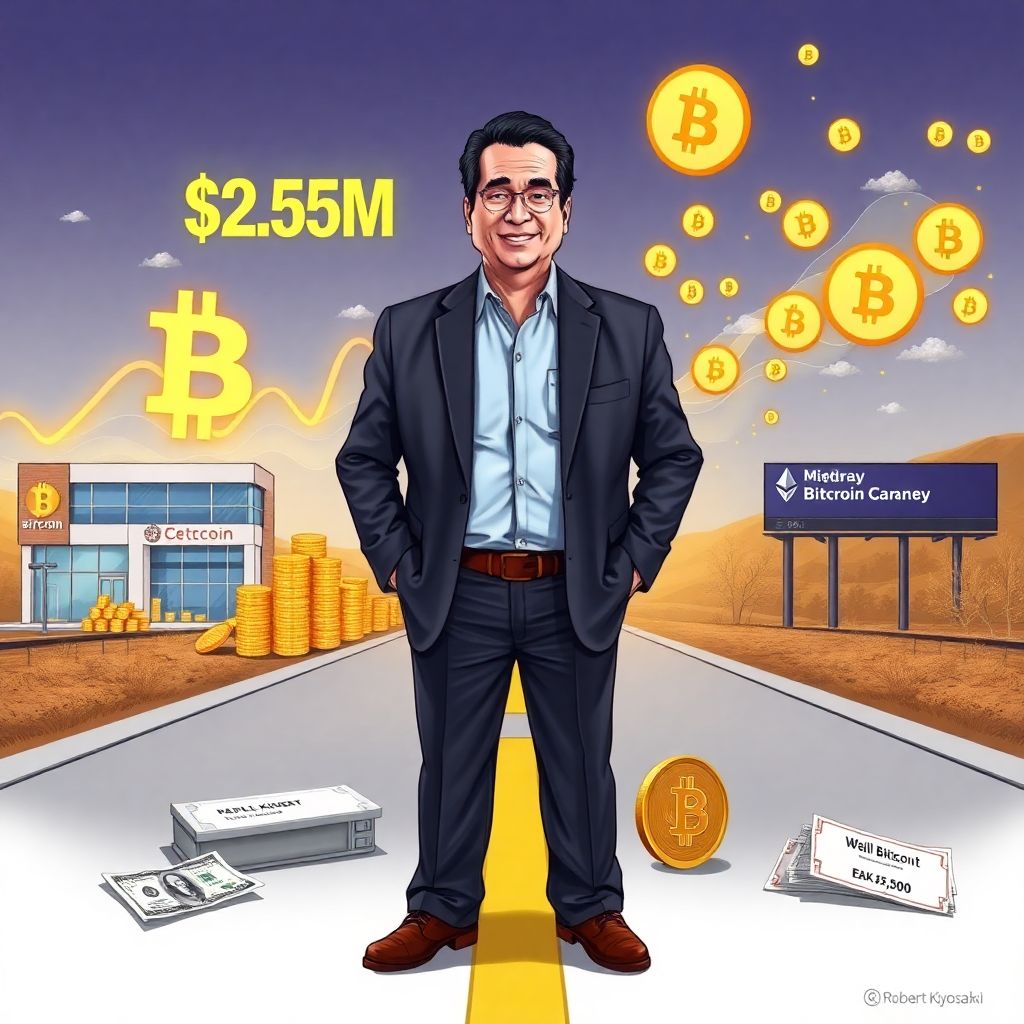
Robert Kiyosaki Cashes Out $2.25M in Bitcoin at $90K — Without Turning Bearish
Robert Kiyosaki, the outspoken author of “Rich Dad Poor Dad,” has locked in a major crypto win — selling $2.25 million worth of Bitcoin at around $90,000 per coin — and is now rolling that profit into the offline world. Despite the sale, he insists he’s still a long-term Bitcoin bull and sees the move as a step in a broader wealth strategy he has been following for decades.
From $6,000 to $90,000: A Textbook Crypto Profit
Kiyosaki revealed that he originally bought his Bitcoin stash years ago at roughly $6,000 per coin. By exiting a portion of his position near $90,000, he realized enormous gains while Bitcoin was hovering around all‑time highs.
He emphasized that this was not him abandoning Bitcoin or calling a top. Instead, he characterized the sale as part of his personal “get rich plan,” a framework he says he has been applying for more than 65 years — ever since he learned about wealth-building through the board game Monopoly with his so‑called “Rich Dad.” The principle: use appreciating assets to generate enough capital to buy income-producing businesses and real estate.
Turning Digital Gains Into Real-World Cash Flow
Rather than letting his gains sit in cash, Kiyosaki is redeploying the $2.25 million into three traditional, physical-world ventures:
– Two surgery centers
– A billboard advertising business
According to his estimates, these investments should start throwing off about $27,500 per month in tax‑free income by February 2026. In other words, he is trading volatile capital gains from Bitcoin for steady, recurring cash flow from operating businesses and real assets.
He framed the move as a classic Rich Dad philosophy play: let assets work for you, then convert speculative upside into stable, long‑term income streams.
Still “Very Bullish” on Bitcoin
Despite liquidating a multimillion-dollar chunk of his Bitcoin, Kiyosaki stressed that his conviction in the asset class remains intact. He described himself as “very bullish and optimistic on Bitcoin” and made clear that he sees this as a tactical reallocation, not a change of heart.
His plan, as he outlined it, is to use the positive cash flow from the surgery centers and billboard business to accumulate even more Bitcoin over time. In other words, he is turning one successful Bitcoin bet into businesses that will then help him buy additional Bitcoin in a more systematic, cash‑flow‑backed fashion.
“My Plan Is Not Your Plan”
Kiyosaki was quick to point out that his strategy isn’t meant to be a template for everyone. On social media, he acknowledged that legendary investor Warren Buffett would likely view his plan as “too slow and foolish.”
He also disclosed that advisers warned him not to share details about both the sale of his Bitcoin and the acquisition of the real‑world businesses. He alluded to security and privacy concerns, writing that there are “too many sickos out there,” indicating that high‑profile investors often face real‑world risks when publicly revealing large financial moves.
Clash of Philosophies: Kiyosaki vs. Buffett
Kiyosaki has long positioned himself as a critic of traditional Wall Street thinking, and Bitcoin has become a new battleground in that philosophical divide. In a November post, he responded to Warren Buffett’s long-standing dismissal of Bitcoin as speculation rather than investing.
Kiyosaki pushed back by pointing out that supposedly “safe” and “traditional” assets can and do collapse:
– Stock markets experience severe crashes
– Real estate values can fall sharply
– Even US government bonds — often considered among the safest instruments on earth — are being reduced by major global holders such as the central banks of Japan and China
His argument: no asset is risk‑free, and dismissing Bitcoin as speculation while ignoring vulnerabilities in legacy instruments is intellectually inconsistent.
Three Kinds of Money: God’s, People’s, and “Fake”
To explain his worldview, Kiyosaki divides money into three broad categories:
1. “God’s Money” – Gold and silver
2. “People’s Money” – Bitcoin and Ethereum
3. “Fake Money” – Fiat currencies and financial instruments tied to the Federal Reserve, governments, and Wall Street
In his framework, gold and silver are timeless stores of value, Bitcoin and Ethereum are decentralized assets outside government control, and fiat money — along with financial products built on it — is ultimately backed by political promises and central bank printing, not by scarcity.
This is why Kiyosaki frequently criticizes what he calls “fake” money systems. He argues that constant expansion of the money supply erodes purchasing power and silently taxes savers, while scarce assets like Bitcoin benefit from that erosion over the long term.
Why He Rejects Bitcoin ETFs as “Fake Bitcoin”
Even though Kiyosaki is bullish on Bitcoin itself, he wants nothing to do with Bitcoin exchange‑traded funds (ETFs). He labels these products “fake Bitcoin” and places them in the same bucket as “Wall Street money.”
His stance is uncompromising: he says he will never invest in gold, silver, or Bitcoin ETFs. In his view, paper claims and derivative products are inherently inferior to direct ownership of the underlying asset.
To Kiyosaki, owning Bitcoin through an ETF means trusting intermediaries, custodians, and Wall Street structures — the very system he believes Bitcoin was designed to circumvent. That’s why he prefers holding actual coins over exposure via financial products engineered by large institutions or favored by investors like Buffett.
Scarcity vs. the Printing Press
At the core of Kiyosaki’s Bitcoin thesis is a straightforward macro argument: Bitcoin has a hard cap of 21 million coins, while government-issued money can be produced virtually without limit.
For him, the contrast is simple:
– Bitcoin supply is mathematically constrained
– Fiat currencies are subject to political cycles, emergency measures, and central bank interventions
He sees that structural scarcity as the fundamental reason why Bitcoin has long‑term upside in a world where stimulus, deficits, and money-printing have become policy norms rather than rare exceptions.
What His Move Really Signals for Investors
Kiyosaki’s decision offers several lessons for individual investors trying to interpret his actions:
– Profit‑taking does not equal bearishness. Selling part of a position after a massive run‑up can be sound risk management, even if you still believe in the asset’s future.
– Diversification matters. Converting volatile, high‑beta assets like Bitcoin into steady cash‑flowing businesses can reduce overall risk while preserving upside.
– Asset rotation can be strategic. Kiyosaki is effectively turning speculative gains into long‑term income, then planning to use that income to accumulate more of the same scarce asset.
Rather than a simple “Bitcoin is overvalued” signal, his move reads more like: “Use volatility to build permanent, real‑world wealth — and then come back for more.”
Bitcoin as a Tool, Not a Religion
Another important takeaway is how Kiyosaki views Bitcoin not as an end in itself, but as a means to a broader goal: financial independence through cash‑flowing assets.
Many crypto holders treat their coins as something never to be sold. Kiyosaki’s behavior cuts against that maximalist mindset. For him:
– Bitcoin is a powerful wealth accelerator
– Real businesses and tangible assets are the foundation of lasting financial security
– The ideal path is to cycle between them — crypto gains into cash flow, cash flow back into scarce assets
That mindset may resonate with investors who like Bitcoin but also want to anchor their net worth in more predictable, offline income streams.
Long-Term Conviction With Short-Term Flexibility
Kiyosaki’s strategy underscores a blend of strong long-term conviction with tactical flexibility. He believes in Bitcoin’s multi‑decade potential, yet he’s willing to trim his position when prices surge and redeploy capital into less speculative opportunities.
This approach can help investors avoid binary thinking — it’s possible to be pro‑Bitcoin while still:
– Taking profits at key levels
– Reducing risk exposure in overheated markets
– Reinvesting into assets that pay you consistently, regardless of the crypto cycle
What This Means for the Broader Crypto Narrative
Moves like Kiyosaki’s challenge two dominant narratives at once:
– The traditional view that Bitcoin is purely speculative and has no place in a serious portfolio
– The hardcore crypto view that “real believers” should never sell
Instead, his actions sketch out a middle path: treat Bitcoin as a high‑potential asset in a diversified wealth strategy, not as a religion or a scam. Use it when it works in your favor, but don’t depend on it exclusively for your future.
The Bottom Line
Robert Kiyosaki’s sale of $2.25 million in Bitcoin at around $90,000 per coin is not a capitulation; it’s a rotation. He’s converting outsized digital gains into real‑world, tax‑advantaged cash flow via surgery centers and a billboard business, while maintaining that he’s “very bullish and optimistic on Bitcoin.”
He still believes in Bitcoin as “People’s Money,” rejects Bitcoin ETFs as “fake Bitcoin,” and anchors his conviction in the contrast between Bitcoin’s fixed supply and governments’ ability to print unlimited fiat.
For investors watching his moves, the message is clear: you can believe deeply in an asset’s future and still take profits, diversify, and build durable income streams that will fund your next round of accumulation.