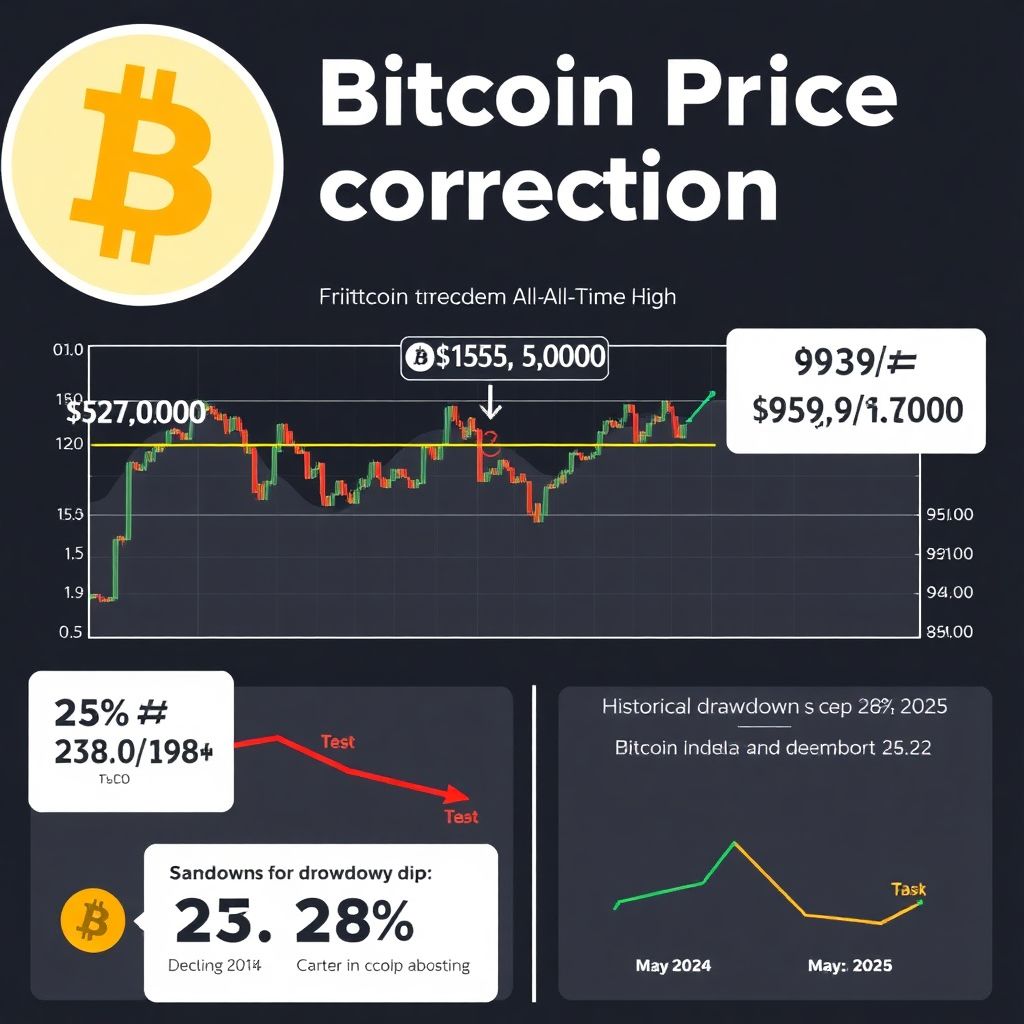
Bitcoin’s recent price correction, while substantial in scale, remains notably less severe compared to previous major downturns in its market history. After slipping from the psychological level of $100,000, Bitcoin is currently trading within a narrow band between $95,000 and $95,100. Despite the volatility and rising anxiety among investors, especially those holding for the short term, this drawdown is still milder than some of the most significant corrections recorded in recent years.
The cryptocurrency reached an all-time high of approximately $126,000 before entering its current bearish phase. Although many market participants interpret the recent decline as intense, blockchain analytics paint a more nuanced picture. According to analyst and market observer Darkfost, the ongoing correction has so far resulted in a 23% price drawdown. This figure, while notable, falls short of the 26% and 28% pullbacks observed in September 2024 and May 2025 respectively.
Corrections of this magnitude occur regularly within Bitcoin’s market cycles and are not inherently alarming. Historical data on Bitcoin’s drawdown metric supports the view that the current retracement fits within expected cyclical patterns. What distinguishes the present scenario, however, is the emotional reaction of market participants—especially those who entered the market recently.
Darkfost also analyzed the “Percent of Bitcoin Supply in Profit” metric to assess the real impact of the correction. While the current dip may not be the steepest, it has had a disproportionate psychological impact, primarily on short-term holders. The percentage of BTC supply in profit has declined to 68%, following a sharp price drop to $93,000. This is the lowest profitability level seen since October 2023, indicating growing unease among investors who bought in during the recent bull run.
This unease is materializing in the form of panic-selling. Over the weekend, short-term holders moved more than 65,000 BTC to centralized exchanges, a strong indication of capitulation. These transactions, often made at a loss, suggest that these investors are exiting the market in a bid to avoid further financial damage. If a significant portion of these coins is sold, the market could experience additional downward pressure, potentially accelerating the decline in Bitcoin’s price.
The movement of such a large volume of BTC onto exchanges is typically seen as a bearish signal. It reflects a loss of confidence among a subset of investors who are more sensitive to short-term price movements. Historically, these panic-driven sell-offs have often preceded either deeper corrections or, conversely, marked the bottom of a downtrend, followed by a period of consolidation and eventual recovery.
However, it’s important to note that long-term holders remain relatively steady. On-chain metrics show that coins held for over 155 days have not yet moved in large quantities, suggesting that seasoned investors are not reacting emotionally to the current volatility. This behavior supports the theory that the correction, while sharp, may not signal the beginning of a prolonged bear market.
Market analysts also point out that macroeconomic conditions and institutional interest continue to play a significant role in shaping Bitcoin’s price trajectory. The recent outflows from Bitcoin ETFs, totaling around $137 million, may have contributed to the recent downturn, as institutional sentiment appears to have cooled in the short term. However, Bitcoin’s increasing integration into traditional financial systems and its correlation with macroeconomic indicators suggest a maturing asset that is slowly shedding its speculative-only image.
While short-term price action may be discouraging to new investors, it’s essential to view this correction in the context of Bitcoin’s broader adoption cycle. The cryptocurrency has historically undergone steep corrections followed by strong recoveries that often set new all-time highs. The current pullback may serve as a healthy reset, offering entry opportunities for long-term investors.
Looking ahead, key support levels lie in the $90,000–$92,000 range. A sustained drop below this zone could trigger further selling pressure, while a bounce from this level might indicate a short-term bottom. Traders and investors are advised to keep a close eye on on-chain metrics such as exchange inflows, realized losses, and the movement of dormant coins, which often provide early signals of market direction.
In addition, the sentiment among short-term holders can act as a contrarian indicator. When fear and capitulation reach extreme levels, markets often find a bottom. If the wave of BTC being sent to exchanges starts to slow, it could suggest that the worst of the panic selling is over, setting the stage for stabilization.
Technical indicators also suggest mixed signals. While momentum oscillators like the RSI have dipped into oversold territory on higher timeframes, signaling potential for a rebound, moving averages still point to a bearish short-term trend. This divergence suggests the market may enter a consolidation phase before choosing a more decisive direction.
In conclusion, while the current Bitcoin correction has certainly shaken market confidence—especially among newer participants—it remains within historical norms and does not yet indicate a structural breakdown. As long as long-term holders maintain their positions and macroeconomic conditions don’t deteriorate significantly, Bitcoin’s mid- to long-term outlook remains resilient. Investors should approach the current volatility with caution but also with an understanding of Bitcoin’s cyclical nature.