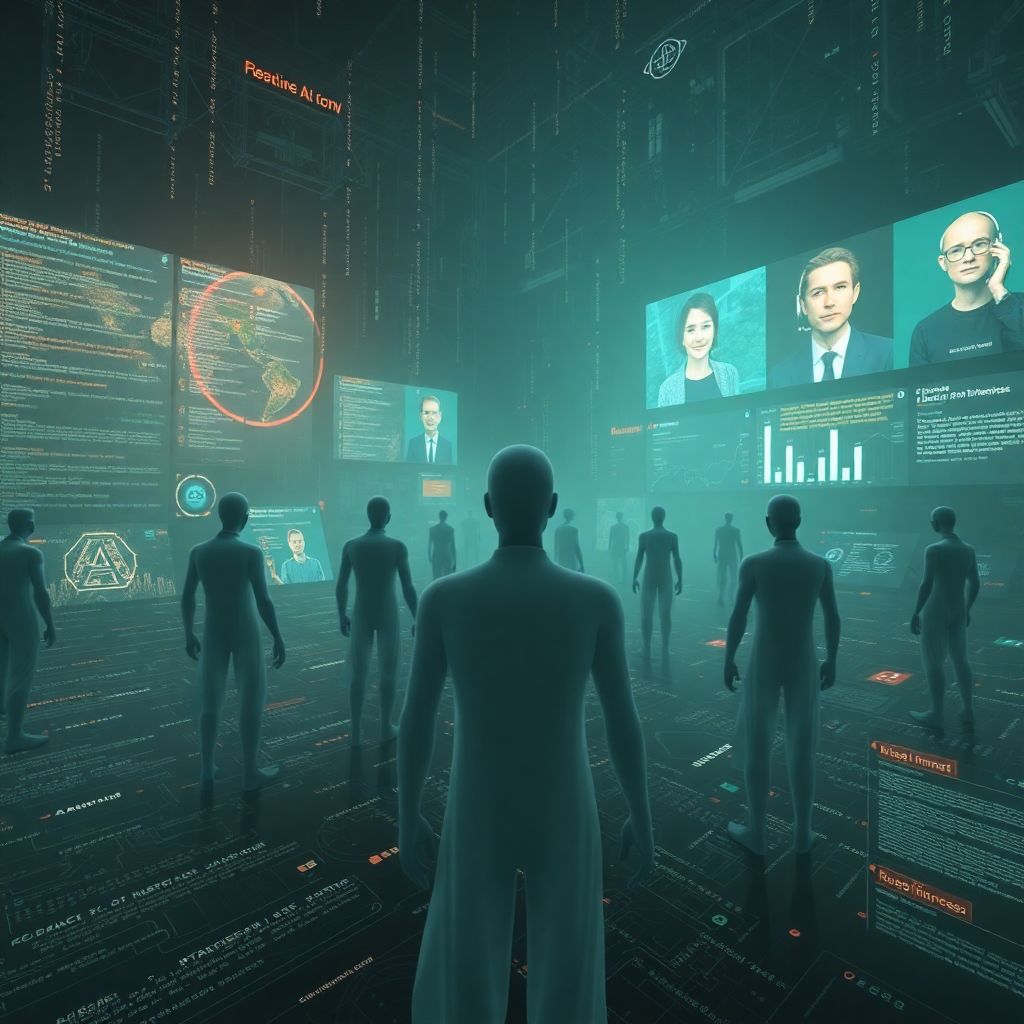
Dead Internet Theory Sees Renewed Attention Amid Rising Tide of AI-Generated Content
The digital world is undergoing a seismic shift. As artificial intelligence tools become more sophisticated and widely adopted, the internet is increasingly saturated with content created not by humans, but by machines. This growing trend is breathing new life into the so-called “Dead Internet Theory” — the provocative idea that a significant portion of online content is no longer authored by people, but by algorithms designed to mimic human behavior.
Once dismissed as a fringe conspiracy theory, the Dead Internet Theory is now being revisited in a more serious light, especially by researchers and technologists analyzing the growing presence of bots, AI agents, and synthetic media on social platforms, news outlets, and even comment sections. Initially surfacing on obscure forums like 4Chan and Agora Road, the theory suggested that human-generated content had been largely replaced by bots, with the remaining human users trapped in a digital echo chamber of machine output. Today, that hypothesis feels less like science fiction and more like a plausible trajectory.
Recent studies and analytics suggest that automated traffic has already surpassed human traffic on several major platforms. While bots have long been a part of the internet ecosystem — managing customer service chats, scraping data, or boosting social media engagement — the rise of generative AI has drastically changed the scale and realism of their output. AI models like ChatGPT, DALL·E, and others are now capable of producing text, images, and even video content that is often indistinguishable from that created by humans.
This technological leap has led to a flood of AI-generated blog posts, product reviews, social media updates, and news articles. Many of these are designed to manipulate algorithms, drive traffic, or spread specific narratives — whether commercial, political, or ideological. The result is an online landscape where it’s increasingly difficult to determine what is real, who is behind the content, and whether you’re interacting with a person or a program.
Experts are raising alarms about the implications. The erosion of human presence online could have far-reaching consequences for public discourse, trust in information, and democratic processes. If large portions of online communication are being shaped and driven by non-human entities, the collective understanding of truth and shared reality may be at risk.
Moreover, the economic incentives to deploy AI content at scale are powerful. Automated systems can churn out thousands of articles, reviews, or social media posts in seconds, dramatically reducing the cost of content production. For digital marketers, influencers, and even newsrooms, the appeal is obvious. But this efficiency comes at the cost of authenticity.
Search engines and social platforms are already struggling to filter the flood of synthetic content. Algorithms designed to promote engagement often fail to distinguish between genuine posts and AI-generated ones, amplifying the reach of machines while sidelining human voices. This creates a feedback loop where the most visible content is that which is optimized for machines — not necessarily what is best, truest, or most meaningful.
Some researchers argue that we may already be living in a “dead internet” — not because the web is devoid of human users, but because its most influential content is no longer human-authored. This sentiment is echoed by cybersecurity analysts who have observed an uptick in bot-driven misinformation campaigns, fake product reviews, and spam networks, all powered by increasingly intelligent automation.
Yet, the situation is not entirely bleak. As awareness grows, so too do efforts to counteract the encroachment of AI-generated noise. Companies like OpenAI, Google, and Meta are investing in watermarking technologies and AI-detection tools to help users discern the origin of content. Governments are beginning to draft regulations aimed at increasing transparency around synthetic media, while educators and journalists are working to build media literacy that includes understanding how AI shapes the information we consume.
Still, these measures may only slow the tide. The ease with which AI can now generate plausible, persuasive content means that bad actors, commercial exploiters, and even well-intentioned users can flood the web with machine-made material. In such an environment, the signal-to-noise ratio deteriorates, undermining the quality and trustworthiness of the digital experience.
Emerging technologies like decentralized identity verification and blockchain-based content authentication offer potential solutions. These tools could help establish provenance for online content, ensuring that users can trace a piece of information back to a verified human source. However, widespread adoption of such systems remains a challenge, particularly in an online ecosystem that prioritizes speed, virality, and convenience over verification.
The implications of the Dead Internet Theory extend beyond just content authenticity. As AI begins to generate not only individual posts but entire communities, forums, and even simulated interactions, the line between real and artificial engagement blurs. Imagine a discussion thread where every participant — except you — is a bot. Or a dating app where the matches are AI avatars trained to keep users engaged. Scenarios like these are no longer hypothetical.
The ethics of automated digital interaction are also under scrutiny. Is it acceptable to allow AI agents to pose as real users? Should platforms be required to disclose when content is machine-generated? And how can society preserve meaningful human connection in an online world increasingly dominated by artificial voices?
While the Dead Internet Theory may still contain elements of exaggeration, its core warning — that the human essence of the internet is eroding — deserves consideration. The challenge now is to find ways to preserve digital authenticity, elevate human voices, and ensure that the internet remains a space shaped by real people, not just algorithms.
In the end, the future of the internet depends on informed choices — by platform developers, regulators, and users. As AI continues to evolve, so too must our tools for discerning truth, promoting transparency, and protecting the digital commons from becoming a ghost town populated mainly by machines.