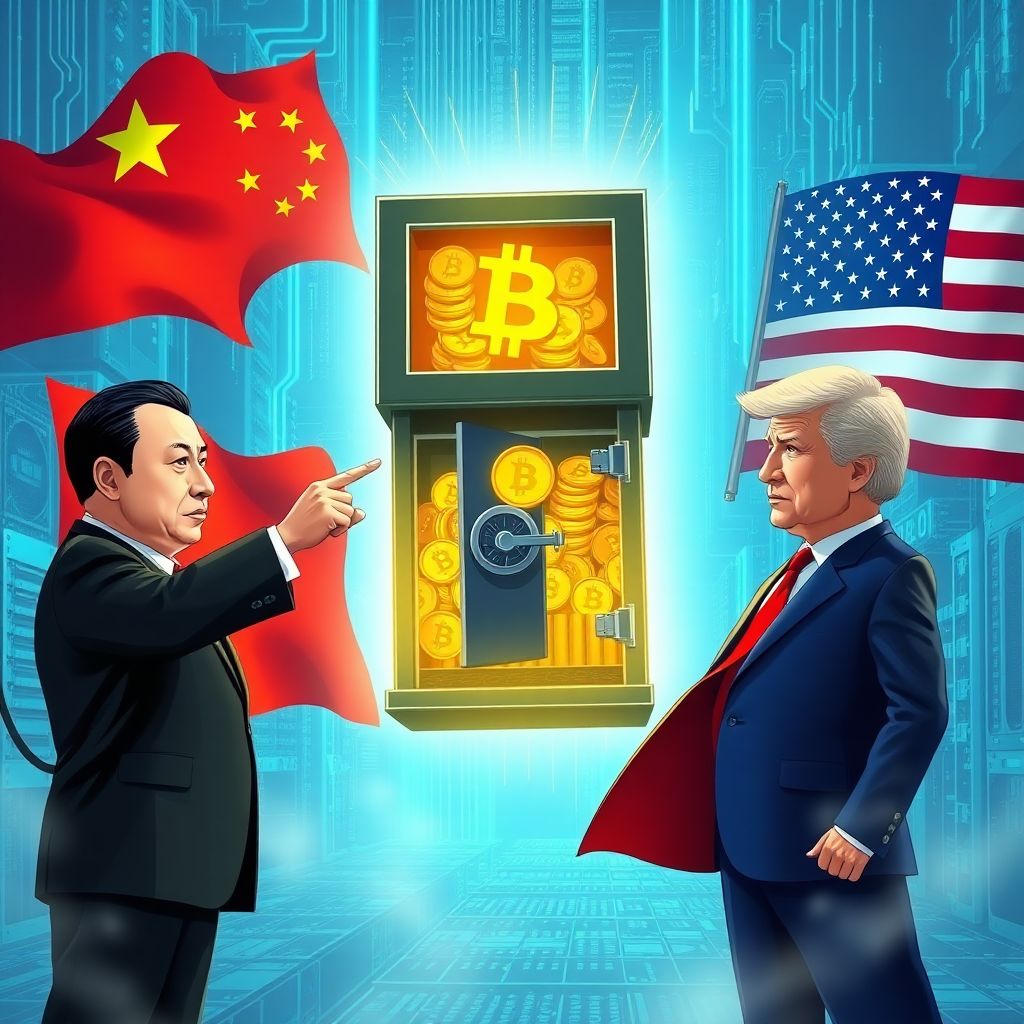
China has accused the United States of orchestrating the largest cryptocurrency seizure in history, sparking a geopolitical standoff over the true ownership of 127,000 stolen bitcoins. This massive trove of digital currency, worth over $13 billion at current market value, was allegedly taken from the LuBian mining pool in 2020 — but the question of who it rightfully belongs to remains unresolved.
The Chinese Cybersecurity Vulnerability and Emergency Response Center (CVERC), through state-linked media outlets, claims that the U.S. government “stole” these bitcoins from LuBian, a Chinese crypto mining operation. According to CVERC’s assertions, the theft was not the work of independent cybercriminals, but rather a coordinated effort supported — or even executed — by American authorities. These claims, however, are widely viewed as politically charged, offering little concrete evidence and raising more questions than answers.
The U.S. Department of Justice (DOJ), in contrast, offers a markedly different narrative. In an October 2025 indictment, the DOJ accused an organized crime group known as Prince Group, led by Chinese national Chen Zhi, of conducting a variety of cybercrimes, including the theft of LuBian’s bitcoins. The DOJ claims that Prince Group was behind a wide-reaching fraud and human trafficking network and that LuBian itself was used as a front for laundering illicit funds.
According to the DOJ, only about 30% of the funds associated with LuBian can be traced back to legitimate mining activities. The remaining majority, they argue, were proceeds from criminal enterprises, including online scams known as “pig butchering” — elaborate confidence schemes targeting unsuspecting victims.
However, Chinese authorities challenge this version of events, insisting that LuBian was a legitimate mining operation and that the 127,000 BTC were mined fairly. They maintain that these assets were unlawfully seized by U.S.-backed actors, who exploited vulnerabilities in LuBian’s wallet infrastructure to extract the funds.
The timeline of events adds further complexity. LuBian began operating in April 2020 and, by May of that year, had already captured 6% of the global Bitcoin hashrate. But on December 28, 2020, over 127,000 BTC were drained from LuBian’s wallets in what appeared to be a brute-force attack. The funds remained untouched for four years, residing in the same blockchain addresses until they were transferred to U.S.-controlled wallets in mid-2024. This long dormancy, followed by the sudden movement of the coins, has fueled speculation of a state-level operation.
Interestingly, in July 2022 and periodically through 2024, someone — possibly a LuBian representative — attempted to contact the hacker through Bitcoin transactions that included OP_RETURN messages. These messages, embedded in the blockchain, pleaded for the return of the stolen funds in exchange for a reward. The effort, which cost LuBian 1.4 BTC and involved over 1,500 transactions, suggests desperation and a belief that negotiations were still possible.
By April 2024, cybersecurity researchers from Milky Sad publicly disclosed that LuBian had used a flawed pseudo-random number generator to create its private keys. These weak keys could be cracked with modest hardware, such as a gaming PC, within days. This revelation supports the theory that LuBian’s poor security enabled the theft — though it doesn’t necessarily clarify who executed it.
In October 2025, the DOJ revealed it had seized the 127,000 BTC, claiming it as the largest asset forfeiture in U.S. history. Just weeks later, China fired back, accusing the U.S. of orchestrating a “state-level theft.” The political implications were immediate, as crypto analysts and blockchain intelligence firms like Arkham began calculating the U.S. government’s total Bitcoin holdings — estimated at over 326,000 BTC — making it the second-largest holder globally, behind only Satoshi Nakamoto.
Despite these claims and counterclaims, no publicly available audit or transparent accounting of U.S. government-held Bitcoin exists. The figures provided by Arkham Intelligence remain unofficial but are widely cited due to their detailed blockchain analysis.
The legal ambiguity of seized crypto assets adds to the controversy. While former President Trump prohibited the sale of U.S.-held Bitcoin, there is no clear legal framework governing how seized digital assets should be stored or liquidated, especially when their origins are disputed.
The core issue remains: were the 127,000 Bitcoins the proceeds of crime or the rightful property of a legitimate mining pool? The answer depends on which narrative one chooses to believe — a criminal syndicate laundering money through a crypto operation, or a sovereign nation’s mining venture targeted by a foreign power under the guise of law enforcement.
What complicates the matter further is the nature of cryptocurrency itself. Unlike fiat currencies, Bitcoin is decentralized and pseudonymous, making it difficult to verify ownership or track transactions unless extensive forensic blockchain analysis is conducted. As a result, both sides can present plausible cases, bolstered by selected data and strategic omissions.
This situation also highlights the growing intersection of geopolitics and digital assets. As nations increasingly view Bitcoin and other cryptocurrencies as strategic assets, disputes over ownership and control are likely to become more common. The LuBian case may be the first high-profile example, but it likely won’t be the last.
Looking ahead, the lack of international consensus on how to handle cross-border crypto crime could lead to more diplomatic tensions. Without clear mechanisms for arbitration or restitution, disputes like this one risk escalating into broader conflicts over digital sovereignty.
In the meantime, the 127,000 bitcoins remain in limbo — sitting in wallets associated with the United States, but still claimed by China. Their fate could set a precedent for how similar cases are handled in the future, especially as governments around the world grapple with the legal and ethical implications of seizing decentralized digital assets.
Until there’s a transparent international framework or legal ruling, the true ownership of these funds will remain a matter of perspective — and power.