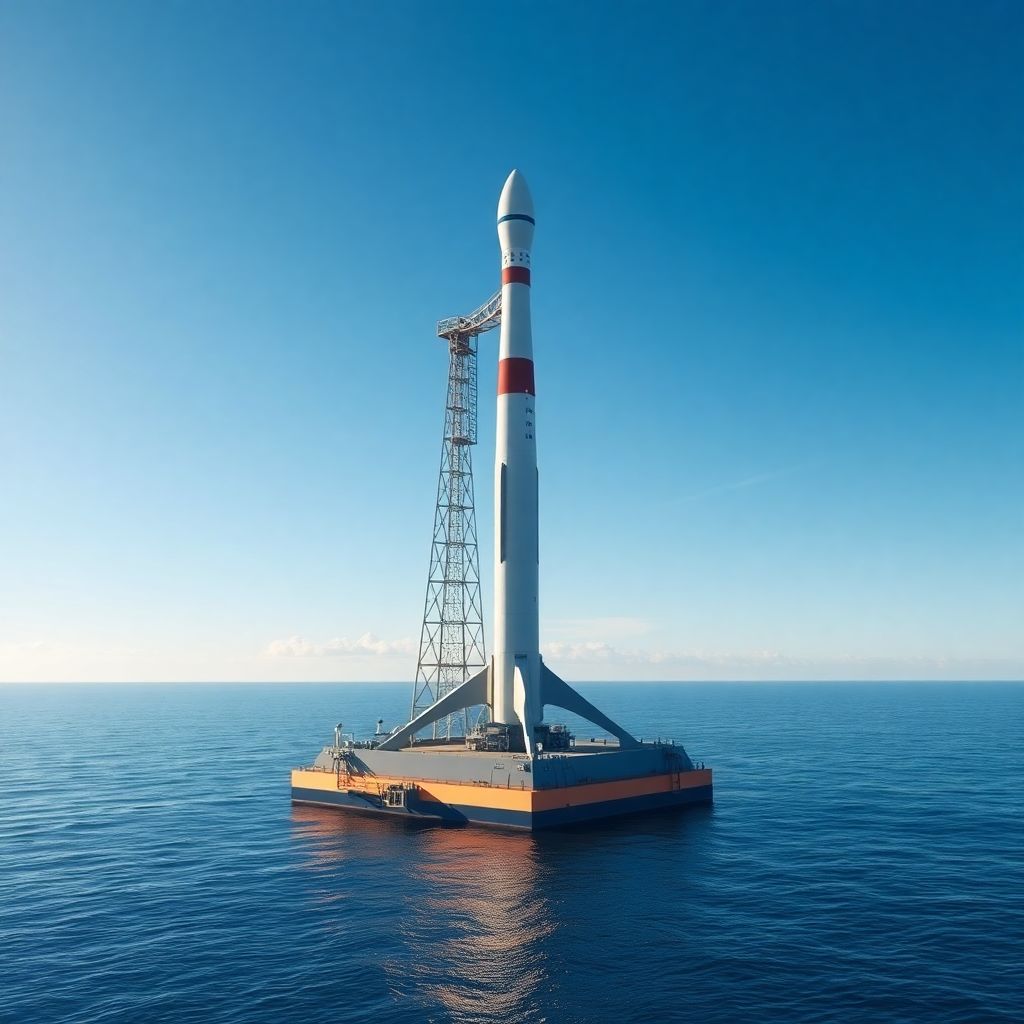
Blue Origin achieved a significant milestone this week with the successful ocean landing of its New Glenn booster, marking the first time the company has recovered the massive first stage of its next-generation rocket. This accomplishment came after the booster launched NASA’s ESCAPADE mission to Mars—a pivotal step forward not only for Blue Origin but for the broader commercial space industry.
The New Glenn rocket lifted off from Cape Canaveral Space Force Station at 3:55 p.m. Eastern Time, carrying NASA’s ESCAPADE mission (Escape and Plasma Acceleration and Dynamics Explorers), a pair of spacecraft designed to study the Martian magnetosphere. Shortly after the launch, the booster executed a controlled descent and landed on an ocean barge stationed in the Atlantic—a maneuver similar to those routinely performed by SpaceX.
This marked the second attempt by Blue Origin to recover the New Glenn booster, with the first ending unsuccessfully. The company’s persistence has paid off, however, as this landing now places Blue Origin in direct competition with SpaceX in the arena of reusable orbital-class rockets, a field that has long been dominated by Elon Musk’s aerospace company.
The ESCAPADE mission itself had experienced a delay earlier in the week due to heightened solar activity. NASA postponed the original launch window as a precaution, citing concerns that increased levels of high-energy solar particles could interfere with the spacecraft’s sensitive onboard electronics. When conditions improved, the launch proceeded without issue.
New Glenn, named after legendary astronaut John Glenn, is a heavy-lift rocket designed to carry both cargo and humans to Earth orbit and beyond. It stands over 320 feet tall and is powered by seven BE-4 engines fueled by liquid natural gas and liquid oxygen. The successful recovery of its first stage demonstrates the vehicle’s reusability, a feature that is central to Blue Origin’s long-term strategy to reduce the cost of access to space.
With this successful landing, Blue Origin has taken a tangible step toward increasing its operational cadence and reliability. The company now joins an elite group capable of both launching and recovering large orbital-class rockets. This capability not only reduces costs but also enables more frequent missions by reusing critical hardware components.
As competition in the commercial space sector intensifies, Blue Origin’s progress underscores the growing maturity of private aerospace ventures. The company is already developing a range of next-gen vehicles, including the Blue Moon lunar lander, designed to support NASA’s Artemis program for returning humans to the Moon.
The successful deployment of ESCAPADE and the recovery of the New Glenn booster also represent a win for NASA’s new approach to leveraging commercial partnerships. By relying more on private companies to deliver missions to space, NASA aims to focus its resources on deep space exploration while stimulating innovation and competition in the private sector.
Looking forward, Blue Origin plans to reuse the recovered booster for future missions, although the company has not yet specified when it will fly again. Engineers will now perform a detailed inspection of the booster to assess the condition of its structure, engines, and avionics after the high-stress launch and landing cycle.
This achievement may also help Blue Origin secure additional government and commercial contracts, as reusability becomes a key factor in mission affordability and sustainability. With the capability to recover and refurbish boosters, the company can offer more competitive pricing to clients and launch more frequently, closing the gap with industry leader SpaceX.
While New Glenn is still in its early operational phase, its successful launch and recovery demonstrates the viability of Blue Origin’s long-term vision. Continued success with booster landings will be critical for validating the platform and paving the way for more complex missions, including crewed flights and deep space exploration.
In the broader context of space exploration, Blue Origin’s accomplishment is a reminder of how rapidly the sector is evolving. Ten years ago, the idea of routinely landing and reusing massive rocket stages seemed far-fetched. Today, it’s becoming the new standard—thanks to the ambitions and innovations of companies like SpaceX and Blue Origin.
As Blue Origin continues to refine New Glenn and expand its capabilities, the aerospace world will be watching closely. The successful ocean recovery of the booster is not just a technical feat, but a strategic victory in the battle to shape the future of commercial spaceflight.