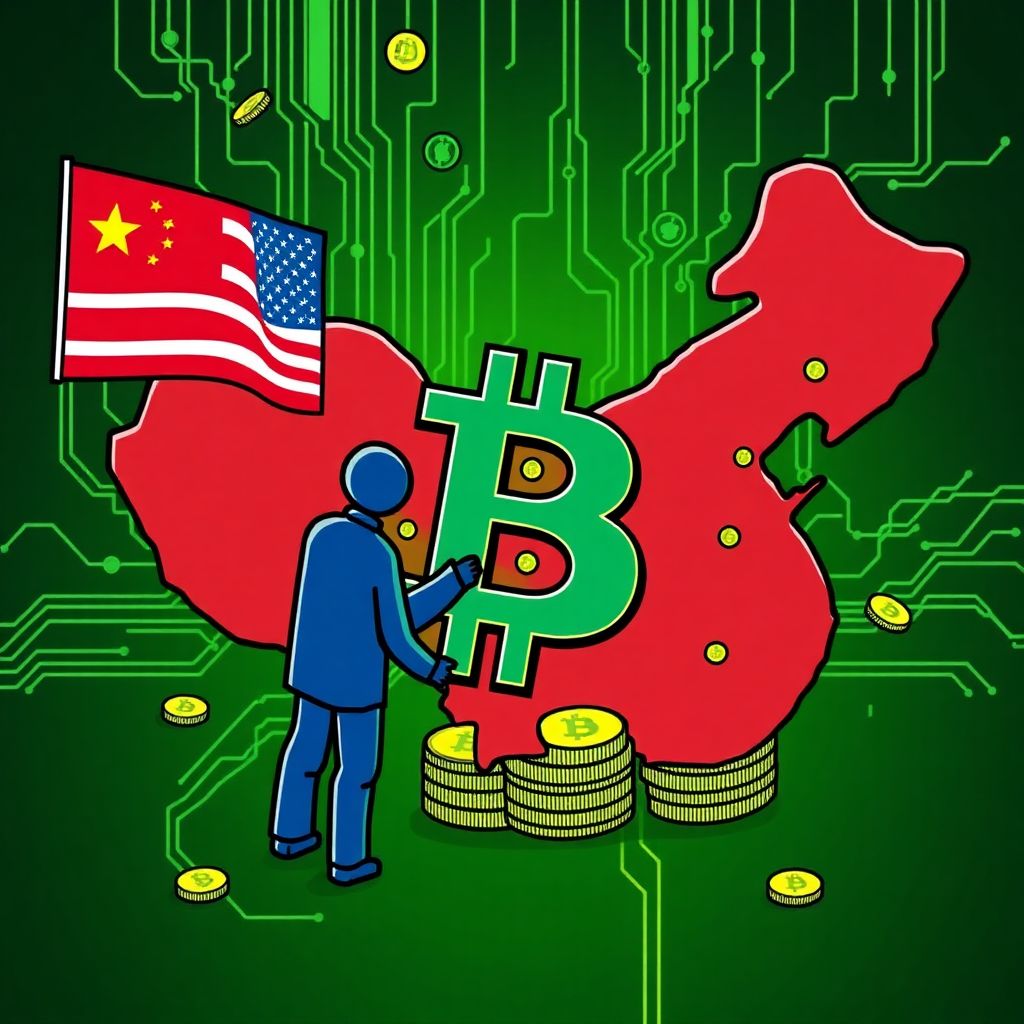
China Accuses U.S. of $13 Billion Bitcoin Theft — Why This Controversy Could Ignite $MAXI’s Ascent
A dramatic accusation from China’s top cybersecurity agency has shaken the global crypto landscape. According to the report, U.S. intelligence agencies allegedly orchestrated the theft of over 127,000 Bitcoin in 2020—assets then worth $2.1 billion, but now ballooned to nearly $13 billion. The BTC reportedly originated from the LuBian mining pool, a major Chinese operation. This alleged breach wasn’t described as a random cyberattack, but rather a methodical state-sponsored operation, aimed at seizing control of valuable digital assets in a move with geopolitical implications.
While the United States has yet to issue a formal response, the serious tone and official nature of the accusation from China signal a new phase in the digital power struggle between world superpowers. This clash highlights how cryptocurrency, once a fringe financial experiment, has evolved into a strategic asset entangled in international politics.
This is more than just a political squabble—it’s a signal to investors. Historically, when government institutions or central banks stir controversy involving Bitcoin, the market often shifts focus to smaller, culturally resonant tokens. These tokens, often meme-inspired or community-driven, represent freedom from institutional control and appeal to a different kind of investor: one driven by community, ideology, and identity.
Enter Maxi Doge ($MAXI), a meme coin designed for the crypto-savvy and culturally rebellious. Drawing inspiration from the maximalist ethos of Bitcoin and the viral magic of Dogecoin, $MAXI has positioned itself not just as a coin, but a movement.
The timing couldn’t be more fitting. In a climate where Bitcoin is increasingly viewed as a tool of global power struggles, coins like $MAXI offer an alternative—an escape hatch into a decentralized future with fewer rules and more community spirit. The allegation of a $13 billion Bitcoin heist could fuel the kind of market volatility that meme coins thrive in, and $MAXI stands to gain significantly from the resulting narrative.
Maxi Doge is more than just a meme—it’s a strategic play in the $36.1 billion dog-themed token market. With 40% of its total token supply dedicated purely to marketing, $MAXI aims to outshine competitors like Dogecoin and Shiba Inu. The project also features the ‘Maxi Fund,’ a war chest for aggressive promotional campaigns and strategic growth initiatives. This level of resource commitment signals serious ambition.
Currently priced at $0.0002675, $MAXI offers staking opportunities with an annual percentage yield (APY) of 77%, appealing to investors looking to generate passive income. A bold price target of $0.0058 by 2026 has been floated, supported by the coin’s strong community engagement and marketing roadmap.
But this surge isn’t just about numbers—it’s about identity. $MAXI thrives by creating a digital tribe around the concept of “maximalism with a wink.” It’s unapologetically crypto-native, celebrating the energy and chaos of the decentralized world. In contrast to the structured, highly regulated environments of traditional finance, $MAXI embraces and even amplifies the disorder that often characterizes crypto markets.
In times of geopolitical upheaval—especially when digital currencies become the center of international disputes—communities often rally around assets that embody resistance and cultural relevance. This is the psychological edge meme coins possess over conventional altcoins. They’re not just investments; they’re statements.
The implication of the alleged Bitcoin theft is profound. If proven—or even if the narrative continues to gain traction—it casts cryptocurrency not just as a financial tool, but as a strategic weapon. And in such a narrative, traditional coins like Bitcoin may be seen as compromised or institutionally manipulated, while community-driven tokens like $MAXI stand out as symbols of independence.
Furthermore, the tension between the U.S. and China over crypto dominance may accelerate decentralization trends. As governments clamp down, users and investors may seek refuge in tokens that resist centralized control. $MAXI, with its grassroots branding and decentralized appeal, is perfectly positioned to benefit.
The meme coin’s ethos—”lift hard, trade hard”—is more than just sloganism. It reflects a growing sentiment among retail investors who want more than just returns; they want involvement, identity, and influence within the projects they support. $MAXI offers all of that and more.
Additionally, $MAXI’s presale, which has already exceeded $3.9 million, indicates strong early interest. The token’s developers have emphasized transparency and community participation, further distinguishing it in a sector often criticized for rug pulls and lack of accountability.
Looking ahead, the broader implications of state-level cyber operations in the crypto space could redefine how traders assess risk and opportunity. As Bitcoin and other major assets become increasingly politicized, meme coins like $MAXI could emerge as symbols of financial freedom and cultural defiance.
Moreover, if geopolitical tensions continue to escalate, we could witness a paradigm shift where narrative-driven tokens outperform based on sentiment and symbolism alone. In such a climate, $MAXI could capture not just market share, but cultural significance.
In conclusion, the alleged $13 billion Bitcoin heist might not just be a flashpoint in international relations—it could be a catalyst for a new era in crypto investing. An era where community, culture, and conviction matter more than ever. And in that world, $MAXI isn’t just surviving—it’s thriving.