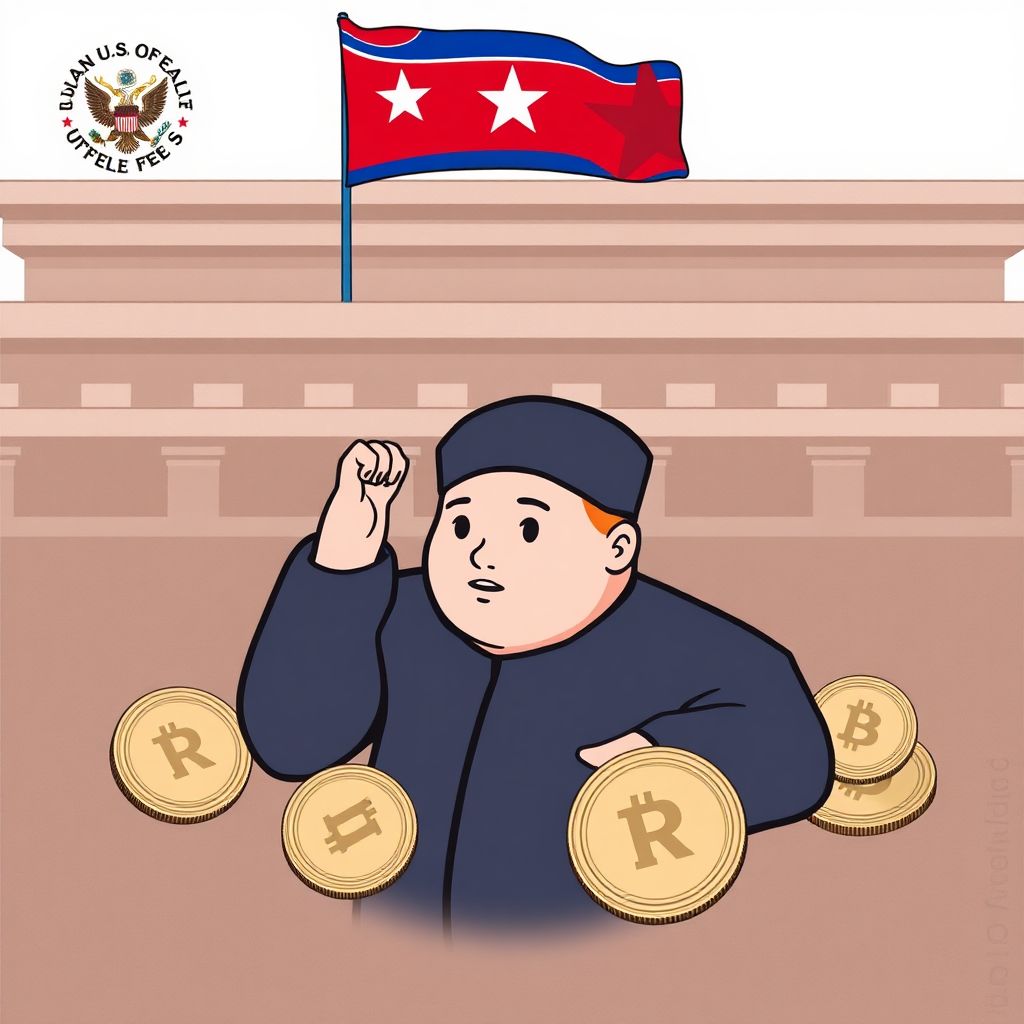
The U.S. Department of the Treasury has imposed a new wave of sanctions targeting a complex network of North Korean individuals and entities allegedly involved in laundering cryptocurrency to support the country’s weapons development efforts. This action singles out eight North Korean nationals operating primarily from China and Russia, whom officials accuse of facilitating the movement of illicit crypto assets originating from cyberattacks and fraudulent IT schemes.
According to the Treasury, these individuals played key roles in obscuring the origin of digital funds stolen by North Korea-linked hackers, particularly those involved in ransomware operations and deceptive IT service contracts. The laundered proceeds were reportedly funneled back to the authoritarian regime to finance its ongoing ballistic missile and nuclear weapons programs.
Alongside the individuals, two North Korean companies were also designated for sanctions. These firms are believed to have actively collaborated with the sanctioned bankers to manage and distribute illicitly obtained crypto assets across international networks. Additionally, the U.S. has blacklisted 53 cryptocurrency wallet addresses connected to the laundering operations. Each of the wallets was found to contain holdings in Tether (USDT), a widely-used stablecoin pegged to the U.S. dollar.
The Treasury emphasized that these wallets were directly tied to the laundering of stolen funds, and warned that any transactions involving them could result in secondary sanctions for third-party actors. The measure is part of Washington’s broader effort to disrupt Pyongyang’s access to global financial systems, particularly through decentralized and semi-anonymous platforms like blockchain networks.
Brian Nelson, Under Secretary for Terrorism and Financial Intelligence, stated that North Korea’s exploitation of cryptocurrency and cybercrime remains a significant threat to global financial security. He reaffirmed the U.S. government’s commitment to dismantling financial infrastructure that enables the North Korean regime to evade sanctions and fund prohibited weapons activities.
In recent years, North Korea has increasingly turned to cybercrime as a primary source of funding amid tightened international sanctions. U.S. and international intelligence agencies have consistently attributed major crypto thefts to groups such as Lazarus, a hacking collective closely linked to the North Korean government. These operations have stolen billions in digital assets from exchanges, DeFi platforms, and private wallets.
By leveraging the relative anonymity and borderless nature of cryptocurrencies, North Korean actors have been able to bypass conventional financial monitoring and enforcement mechanisms. These capabilities make it difficult for authorities to trace and freeze assets before they are converted into usable currencies or valuable goods.
The sanctioned bankers reportedly employed a variety of sophisticated laundering techniques, including mixing services, shell companies, and cross-chain swaps, to obscure the origin and destination of the stolen funds. Some of the crypto was also reportedly funneled through centralized exchanges in jurisdictions with weak anti-money laundering (AML) enforcement.
This latest enforcement action underscores the ongoing evolution of financial threats posed by state-sponsored cybercrime. The Treasury urged crypto companies, exchanges, and financial institutions to conduct enhanced due diligence and remain vigilant for red flags associated with North Korean cyber operations.
In addition to freezing the identified wallets and barring U.S. persons from engaging with the sanctioned individuals and entities, the Treasury also encouraged other governments and private sector actors to adopt similar measures. Coordinated international sanctions, officials argue, are essential to closing off the financial lifelines that support Pyongyang’s destabilizing activities.
Experts warn that as North Korea continues to refine its cyber capabilities, the threat to global crypto infrastructure is likely to intensify. This includes potential targeting of decentralized finance protocols, NFT platforms, and even emerging blockchain-based payment systems.
To counter these threats, regulators are calling for improved transparency in the crypto sector, including mandatory wallet verification, robust KYC (Know Your Customer) procedures, and the implementation of blockchain analytics tools that can flag suspicious transactions in real time.
Furthermore, international cooperation is being highlighted as a critical element in combating illicit crypto flows. Agencies like the Financial Action Task Force (FATF) have been working to establish global standards for digital asset compliance, encouraging countries to implement the so-called “travel rule,” which requires exchanges to share sender and recipient information for crypto transfers.
The growing intersection between geopolitics and digital finance has elevated the importance of cybersecurity and regulatory oversight in the blockchain space. As rogue states like North Korea continue exploiting technological loopholes, the global community faces increasing pressure to adapt, collaborate, and innovate in order to protect financial systems and international security.