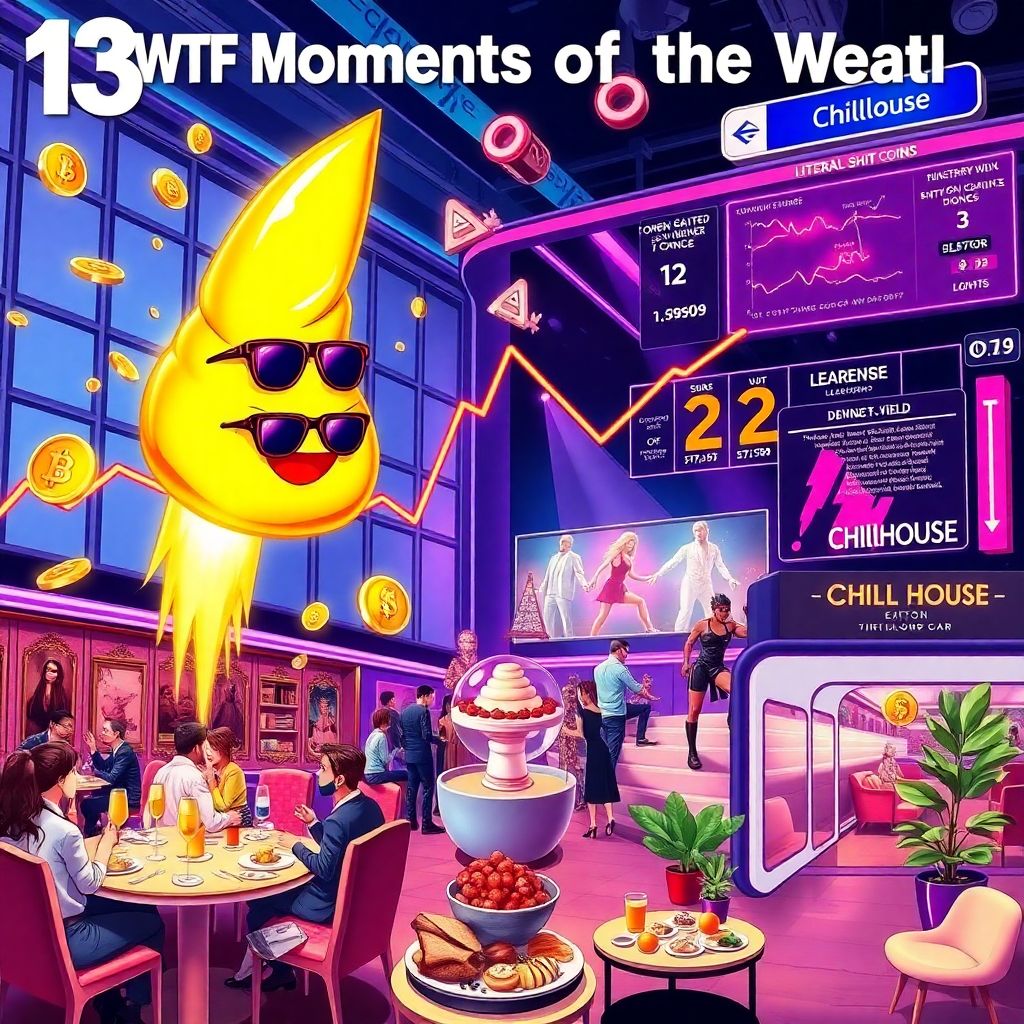
13 WTF Moments of the Year: 2025 Crypto Edition
If you thought crypto had finally “matured” in 2025, the market quickly reminded everyone that this industry’s default setting is chaos. Between meme coins made out of bodily functions, cops wrangling Bitcoin ATMs, and people tokenizing literally everything—from dance moves to dinner—this year delivered a new high score in absurdity.
Here’s a look back at 13 moments that made even hardened degen veterans ask: *What on-chain hell are we living in?*
—
1. When “Literal Shit Coins” Stopped Being a Joke
For years, “shitcoin” was just an insult. In 2025, it became a business model.
A wave of projects launched with branding so on-the-nose it felt like performance art: tokens themed around toilets, sewage, and, yes, actual feces. One “eco-conscious” meme coin claimed it would “offset methane emissions” by funding biogas projects, while its branding featured cartoon poop wearing sunglasses.
Pump groups pushed the narrative, influencers filmed reaction videos pretending to be horrified while quietly stacking tokens, and traders actually made money—until the predictable rug pulls began. Charts that looked like a vertical rocket on day one became straight lines to zero by day three.
Investors didn’t just lose money; they lost the ability to say with a straight face that they only buy “serious projects.” 2025 was the year the market collectively admitted it was willing to speculate on literal garbage, as long as the ticker was funny.
—
2. The Night Your Dinner Became a Token
Fine dining met tokenomics when an experimental restaurant turned a tasting menu into an on-chain asset.
Guests didn’t just book a table—they minted a limited-edition “dinner token” that granted access to a one-night-only menu, curated by a celebrity chef. The twist? The token could be resold on secondary markets before the event. Predictably, some guests flipped their reservation for a profit and never showed up. Others went purely for the flex: “I ate a token-gated soufflé.”
The restaurant tried to build a loyalty loop: holders collected on-chain badges for each visit, unlocking secret dishes and chef’s table invites. Food critics argued about whether this was innovation or a gimmick; crypto Twitter treated it like a live experiment in “culinary DeFi.”
The result: a bizarre hybrid of supper club, speculative asset, and status symbol. People didn’t just post photos of their food—they posted price charts.
—
3. A Token for Your Twerks
By mid-2025, if it moved, it could be tokenized. That included twerking.
A dance creator platform launched a token that let fans “sponsor” choreographies and earn a share of streaming and content revenue generated by those moves. Twerk-focused routines quickly dominated the leaderboard, because of course they did.
Fans bought fractional rights to viral dances, hoping a clip would blow up on short-form video apps and generate recurring income. Dancers organized on-chain competitions where votes were cast with governance tokens. People were literally yield-farming dance routines.
Critics called it the gamification of bodies; supporters framed it as dancers finally owning their work instead of platforms and intermediaries capturing all the value. The ethical debate was complicated, but the spectacle was undeniable: an entire subculture trading, staking, and speculating on twerks.
—
4. Chill House Wasn’t So Chill After All
A buzzy “chill” NFT project promised a serene digital escape: spa-like virtual spaces, ambient music, and token-gated lounges where holders could decompress from the volatility of the markets.
Then, inevitably, drama.
Users discovered that some of the “meditative soundscapes” were suspiciously similar to popular tracks licensed elsewhere. The project’s DAO exploded into arguments over intellectual property, artist royalties, and whether the team had cut corners or simply misunderstood licensing.
Discord channels meant for mindfulness spaces turned into battle zones. The project that marketed itself on relaxation ended up delivering panic, accusations, and frantic governance proposals. Holders memed it mercilessly: “Come for the chill vibes, stay for the legal anxiety.”
The irony was too perfect to ignore: a wellness-themed collection triggering some of the most stressful debates of the year.
—
5. The Jack Off 500: When Degeneracy Went Full NASCAR
The line between satire and reality disintegrated with the emergence of a meme coin sporting a name so explicit most outlets refused to print it in full. Its creators leaned into the absurdity with a pseudo-competition dubbed the “Jack Off 500,” a race to see which wallet addresses could hold the largest positions the longest without selling.
Leaderboards ranked “most diamond-handed degenerates,” complete with custom avatars and badges. Some participants locked in their tokens using smart contracts purely for bragging rights, proving they couldn’t sell even if they wanted to.
On one level, it was juvenile humor and pure speculation. On another, it was a weirdly sincere experiment in game theory, testing how far status incentives and social pressure could push people to hodl a coin whose entire value proposition was its own stupidity.
The result: fortunes made and lost on an in-joke that went way too far—and a reminder that nothing is too crass for a pump if the meme is strong enough.
—
6. Dumpster Diving for Dollars—Literally
The long-running legend about someone digging through a landfill for a lost hard drive full of Bitcoin found a spiritual sequel in 2025.
This time, a group of treasure hunters organized a tokenized scavenger operation to recover discarded hardware wallets and laptops from old e-waste sites. Backers purchased tokens representing fractional rights to any digital assets recovered.
Reality did not match the fantasy.
Yes, a few dusty wallets were found with small balances of forgotten altcoins, most of which were now worthless. But the story took off when a viral clip showed a participant wading through trash, triumphantly holding up a mouldy keyboard while a friend shouted its estimated “on-chain potential.”
The project blurred the line between environmental reclamation and speculative theater. Was it sustainable tech archaeology or just people playing DeFi Indiana Jones in a junkyard? Either way, it immortalized one of the most surreal images of the year: investors literally sifting through garbage in hopes of striking digital gold.
—
7. Getting Buzz and Influencing People
“Buzz” became both a person and a business model.
A hyper-charismatic influencer launched a personal brand token, promising holders access to private streams, merch drops, and even a say in which sponsorships they’d accept. The token’s tagline boiled down to: “If you’re going to watch me sell you stuff, you should at least get a cut.”
Brands lined up. Campaigns were proposed, voted on by token holders, and greenlit if the community approved the reward structure. Fans debated whether they were empowering creators or just formalizing parasocial relationships into financial contracts.
Then came the chaos: leaks of backroom deals, accusations of vote buying, and dramatic governance battles over whether to accept certain advertisers. The experiment raised hard questions: At what point does “community ownership” become a thin veneer over old-school marketing? And how much influence should fans really have over an individual’s career?
Still, the model worked well enough to spawn copycats, cementing 2025 as a turning point in the tokenization of influence itself.
—
8. “You Too Can Create a Treasury” Becomes a Business
The tools to spin up DAOs had been around for years, but 2025 turned “launch your own treasury” into a packaged consumer product.
No-code platforms started offering plug-and-play DAO kits where users could create a token, set up multi-sig wallets, define basic rules, and deploy a governance structure in under an hour. Templates ranged from “friends pooling money to buy stuff” to “fan club with voting rights” to “neighborhood treasury for local projects.”
Some experiments were heartwarming—residents funding community gardens, small creators collectively covering production costs, or niche hobby groups building shared treasuries. Others were chaotic: poorly designed voting systems, vanished organizers, and treasuries stuck in limbo when key signers disappeared.
The vibe was a strange mix of empowerment and confusion. For every genuinely thoughtful community fund, there was a half-baked cash pool with no clear purpose, created because people had just discovered they *could*.
In the process, “creating a treasury” stopped being an institutional thing and became something anyone with a smartphone could try, for better or worse.
—
9. Lone Star Cops Lasso a Bitcoin ATM
In one of the most cinematic scenes of the year, law enforcement in Texas seized a Bitcoin ATM as part of a local investigation, and the photo of officers hauling the machine away immediately went viral.
The image—cops loading a bright orange crypto kiosk into the back of a truck—became an instant meme. Some saw it as a symbol of regulators finally catching up; others treated it as proof that the traditional system still struggles to understand what it’s dealing with.
Commentary exploded around a serious underlying issue: how lightly regulated some of these ATMs had been, and how susceptible they were to misuse, sloppy compliance, or outright scams. What looked like a slapstick moment was actually a window into a messy gray zone where physical cash, digital assets, and patchwork local laws collide.
What stuck in the public imagination, though, was simple: a literal “crypto cowboy” moment, starring a confiscated machine instead of a horse.
—
10. “Melania Bolognia” and the Year of Surreal Political Memes
If 2021 had NFTs of political figures, 2025 had something stranger: edible, meme-based collectibles inspired by public personalities.
One of the most notorious was a tongue-in-cheek line of meat-themed parody art riffing on a former First Lady’s highly polished image. Wrapped in absurdist humor and surreal visuals, the project combined on-chain art with limited-edition physical items that looked suspiciously like high-end deli packaging.
Lawyers apparently circled, statements were parsed, and the whole episode walked a legal tightrope between parody and provocation. It raised a familiar but still unresolved question: where do we draw the line in a world where anyone can mint an NFT riffing on anyone else?
Ultimately, the episode said more about the culture than the subject: politics, celebrity, and crypto are now so entangled that satirical tokens and collectibles feel almost inevitable.
—
11. BOOM Headshot: When Gaming and DeFi Collided Too Hard
On-chain gaming promised player-owned economies. In 2025, one shooter game pushed that concept to such extremes it broke its own ecosystem.
Every in-game “headshot” awarded tokens, NFTs, or loot boxes that could be traded on external markets seconds later. Skilled players farmed rewards relentlessly, turning matches into high-stakes income streams. Bots flooded the platform. Market makers started arbitraging in-game assets across chains.
Then a balancing patch accidentally buffed a particular weapon, creating an overnight arbitrage meta where a handful of users earned outsized rewards. The in-game economy went vertical and then imploded as developers scrambled to roll back changes and patch exploits.
The episode illustrated a brutal lesson: once a game’s mechanics are deeply financialized, design mistakes stop being just “balance issues” and turn into real monetary blowups. “BOOM headshot” was no longer just an audio clip; it was the sound of token prices crashing.
—
12. Dogwifhat Meets Its Match—But Not Wif Sphere
Dogwifhat, the memecoin with the now-iconic dog-in-a-pink-beanie aesthetic, spawned a flood of imitators in 2025. The strangest chapter came when a completely unrelated project tried to piggyback on its fame with a similarly named token and a series of “creative reinterpretations” of the original imagery.
Lawyers, artists, and armchair IP experts clashed over what counted as fair homage versus brand dilution. Exchanges hesitated to list the newcomer, unsure if they were inviting a legal fight. Holders accused one another of being “fake wifhat enjoyers” or “sphere shills,” turning a simple hat-wearing meme into a full-blown identity war.
Underneath the memes lay a real issue: how do you enforce intellectual property norms in a culture that thrives on remixing? Dogwifhat’s saga turned into a test case for whether viral on-chain icons can be protected in any meaningful way.
—
13. “Yu Gotta Be Kidding”: The Metaverse Plot Twist
Just when it seemed like metaverse fatigue had fully set in, one of the most hyped virtual-world projects of the early 2020s pulled a whiplash-inducing maneuver in 2025.
After years of promising a fully immersive social world, the team pivoted sharply to a stripped-down, mobile-first experience that looked less like a game and more like a social shopping app with land deeds. Legacy landholders who had spent serious money on virtual plots woke up asking the same thing: *Yu gotta be kidding.*
Assets were re-labeled, experiences were “reimagined,” and early adopters struggled to determine where their sunk costs fit in the new vision. Some praised the move as a realistic adjustment to how people actually spend time online. Others saw it as a bait-and-switch that turned a dream of digital sovereignty into yet another branded retail funnel.
The move crystallized a bigger tension: are metaverse projects building community-owned worlds, or just next-generation malls?
—
What These WTF Moments Really Say About 2025
Beneath the spectacle, 2025’s most absurd crypto stories shared a few themes:
– Everything is now fair game for tokenization – dinners, dances, influence, memes, treasuries, and even trash. The boundary between “online culture” and “financial asset” almost disappeared.
– Tools got easier, so experiments multiplied – low-code DAOs, creator tokens, and plug-and-play contracts meant anyone could launch something wild in an afternoon. That democratization brought both creativity and chaos.
– The legal and ethical questions are catching up – whether it’s parody projects, knockoff memes, or over-financialized games, the frictions between old-world rules and new-world tech are becoming impossible to ignore.
– Speculation remains the core engine – even the strangest ideas found traction if they offered upside, a good meme, or a social flex. Rationality still plays second fiddle to narrative and hype.
—
How to Stay Sane in a Year of Chaos
If you plan to stick around for the next cycle of WTF moments, a few guidelines are becoming timeless:
– Assume anything can pump—but most things won’t last. Meme velocity is not the same as staying power.
– Check who actually controls the money. DAOs, treasuries, and creator tokens often have central chokepoints behind their “community” branding.
– Look beyond the meme to the mechanism. If you can’t clearly explain how value is created and who benefits, you’re probably the product.
– Treat cultural experiments as experiments. Some of these ideas genuinely push the boundaries of ownership, art, and community—just don’t confuse that with guaranteed returns.
—
The Inevitable Next Level of WTF
The story of crypto has always been weirder than anyone expected: born from a pseudonymous manifesto, adopted by misfits and institutions alike, and constantly oscillating between idealism and degeneracy.
If 2025 taught us anything, it’s that the industry’s strangest chapters are not bugs in the system—they’re features of a world where code, culture, and money are permanently fused.
The price charts will rise and fall, narratives will rotate, and new buzzwords will replace the old ones. But one thing is almost guaranteed: next year’s list of WTF moments will make 2025 look tame.